Where Closed Loop and Emergent Innovation Meet
Organizations are optimized for performance: few are structured to sustain both performance and adap
For decades, organizations have designed and relied on closed loop systems to drive efficiency, consistency, and control. These systems are highly effective in environments where outcomes are known, variability must be minimized, and performance can be measured with precision.
They are the backbone of modern business—but they are not designed to manage everything.
As organizations become increasingly dependent on human capacities—adaptability, judgment, collaboration, and innovation—a different kind of system begins to operate alongside them.
One that cannot be fully controlled, predicted, or optimized through traditional methods.
This is where many organizations encounter friction, particularly as technological advancements reshape how people work, interact, and make decisions.
The same structures that drive performance can begin to limit adaptability when applied to human systems.
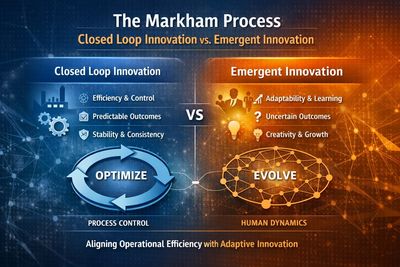
Two Systems. One Synergetic Organization
Closed Loop Innovation
Closed Loop Innovation

Closed loop innovation is designed to optimize efficiency and performance by reducing variability, reinforcing predictability, and ensuring consistent outcomes. It is most effective in environments where processes are repeatable, risks must be minimized, and efficiency is the primary objective.
Emergent Innovation
Closed Loop Innovation
Emergent innovation operates by working with variability, enabling new patterns to arise and form through interaction, learning, and adaptation. It is most effective in environments where outcomes cannot be fully defined in advance and where human capacities for intuition, judgment, creativity, connection and responsiveness are essentiaL
One Synergetic Organization
One Synergetic Organization
Every organization operates with two systems at once: one designed to drive performance through control and predictability, and another required to support adaptability, learning, and innovation. The challenge is not choosing between them, but recognizing where each applies—and designing an organization where both operate in synergy.
THE GAP
You can’t engineer innovation with systems designed to suppress it.
Most systems and technologies—within and beyond organizations, including artificial intelligence—are designed as closed-loop systems. They optimize for control, efficiency, predictability, and performance. These systems have a critical role; however, when applied beyond their intended scope, they can constrain the human capacities required for judgment, attunement, creativity, and adaptability.
Very few organizations are intentionally designed to support both—control where it is needed, and emergence where it is required.
As a result:
- innovation initiatives stall
- change efforts lose momentum
- teams default to compliance over creativity
- organizations struggle to adapt under pressure
The problem is not people—it is the misapplication of systems designed for control in contexts that demand emergence.

THE MARKHAM PROCESS
Where control and emergence work in synergy.
The Markham Process separates where control is required from where emergence must be enabled. It designs the conditions for both—so efficiency is maintained and innovation can actually occur.